8/30/06

A couple of great, great days

The bike ride was just covered in Duke's newspaper, The Chronicle. That's exciting, because it is a newspaper I used to read all the time. The story has also appeared in The Rochester Post.

Last Friday, I hosted my first-ever dinner party, at my lovely apartment in Fort Greene. 8 people were hand-selected to provide the best possible company, and delivered in spades. There was classic country music playing in the background, chips and salsa in the foreground, and a general excitement in the air. Merritt and Josh helped me with the cooking, which wound up as a first course of salad with homemade dressing, a main of arroy con poulet, and a finish of coffee and a bowl of honey, strawberries, and yoghurt. Delic! The next morning I woke up and remembered SW had done all the dishes.
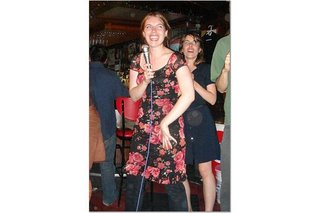


Saturday night was Lucy's bachelorette party, which had a lot of the same people as my dinner, but more as well! We started at Jo's new Bleeker St. HQ, then rallied on to Karioke in chinatown. Click here to see all the pics. Lucy looked totally beautiful and Josh's love of karioke (combined with possible high cholesterol) finally showed up in his side-splitting thalidomide shuffle.

I finally got a ticket on Sunday, when I swerved across 4 lanes of traffic in half a block to get on the southbound FDR (after dropping off Lucy, Manel, and Marta at GCT). It was raining, and my windows were totally foggy. But all was not lost, I had to break my jammed glove compartment open (for proof of insurance), which ended up fixing it.

Just after that, I went to blockbuster to get a movie, and when I came out, a foreign guy was standing there pointing at his car. Apparently, when I had parallel parked (wedging the back of my car into a construction zone) I had mistakenly bumped his car and put a huge dent in the rear bumper. FURY! I had just gotten a ticket, and now this? He said over and over "I need your paper, I need your papers." And after playing dumb for a minute, I thought "F-this", tore off my shirt, crawled under his car (into grimy grit--it was still raining) and pushed as hard as I could on the dent, which reluctantly popped out. Then that guy was shaking my hand, seriously.

8/22/06

RAAAMS!

On my way home to my apartment in Brooklyn today, I came across this rimless Infinity (on 6th and Atlantic). For the last week, a big sticky parking ticket had been on the drivers window. Today, the drivers window and sunroof were shattered, and all four enormous AMG-style aftermarket chrome wheels were gone.


A passerby said she thought the car had been stolen, used to run drugs, and abandoned. She said she was glad it wasn't her car--but I'd be absolutely thrilled to have this beat G35.

Traffic Soln.

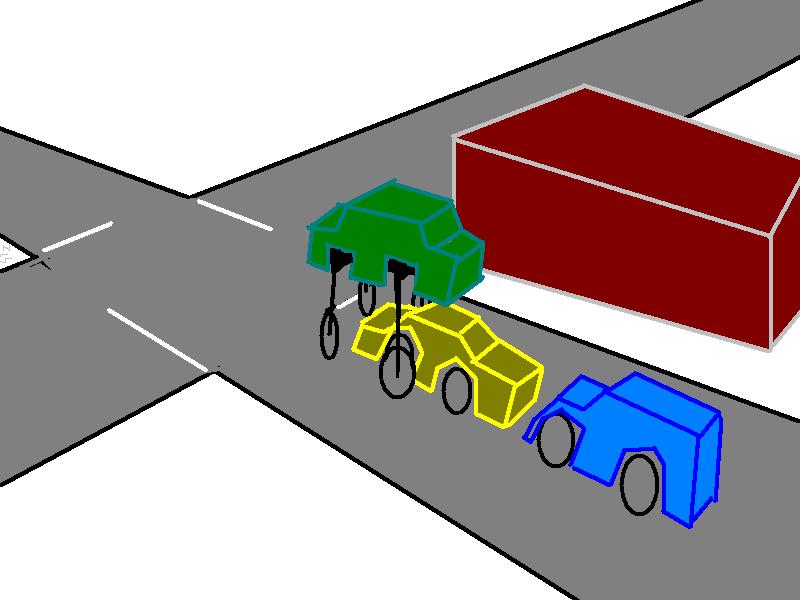
I have come up with a way to solve my problems with NYC traffic-- Forget horns, get a lift kit!

Make something better

The chorus of this fantastic Honda ad has been going through my head as I campaign for safer NY streets through Transportation Alternatives. I first saw the ad last year in England, and just found it again online.


I cannot wait for widespread diesel market penetration in the US passenger car market.

8/14/06

Poor following rich

It sometimes happens that rich people start a trend, then the poor people catch up, then the rich move on.

Long ago, rich people used to be pale (to show that they didn't have to work in the fields). Then, after the industrial revolution, poor people had to work in factories, and rich people got tan, to show that they didn't have to stay inside and work.

Rich people used to be fat, because they could afford a lot of food and be lazy. Poor people couldn't afford much food and had to do physical labor. Now fast food companies sell inexpensive, high-fat foods, while rich people eat very healthily and have personal trainers.

"Ain't" is a contraction for "am not" and used to be proper English, but then the lower classes intergrated it into their speech and the upper class moved on.

Cellular phones, which used to be extremely expensive and for only the richest businessmen, are now in the hands of everyman. And businessmen are wishing that they could put the phones down, so their bosses can't reach them over the weekends or in the evening. Only the bosses can put the phones away, since they don't answer to anyone.

But what's next?

I think it will be wireless internet- There is a push to put wireless internet everywhere, but it can be annoying when cafes fill up with computers during the day. There is very little turnover in wireless cafes, and there is often the eerie quiet of a press room. I bet in the near future cafes will have "no wireless" days, for the old customers who like milk and background chitchat with their coffee.

After wireless? It's going to be cars. There is a growing backlash against cars, and while they might not do noticeable damage to air quality, they are certainly noisy and dangerous. Taking a walk down the middle of a closed road is a rare pleasure these days, but a real pleasure nonetheless.

Proof? Look at these carfree places (hint-they are all places people LOVE to be):

Venice
Whistler
Siena
Zermatt
Parts of London
Makinac Island
Hiltonhead
Williamsburg
Isla Vista (in Santa Barbara)

The list goes on, and they are all great places! Riding and walking are forgotton joys, but they will soon be remembered. Carfree needn't mean impractical.

8/10/06

Be a Mattress King!

Dear readers, I know it has been a long time since I last wrote. Yesterday, while moving a bed for 1871 House in NYC, I came upon a little pamphlet about mattress care. It read:

Do turn your mattress occasionally to prolong the comfort and support life. Body indentations are a normal occurence in your new mattress and indicate that the uphostery layers are conforming to your body's individual contours. You'll be pleasantly surprised with that "New Mattress Feeling" every time you turn your mattress.

How cool! I never knew this, and am going to try it tonight- results tomorrow.

8/1/06

A riddle

Here's an old riddle which just popped into my head (I made it up last year)

Since 1950, the world population has more than doubled, yet the average population per country has decreased. Why?

(put your answer in the comments)

7/30/06

When hearts attack, or “E(xplianing thanol)”

Tofurkey tastes like crap, but high cholesterol can mean a plate of veggie burgers. On a macro scale, mother earth has spiraling cholesterol, will almost certainly have a heart attack, and must start munching tofu dogs and veggie burgers today. They may not taste great, but who wants England to have another ice age? Read on.

While fluctuating gas costs make drivers think about the relationship of money to gasoline and the “cost” of driving, there are some interesting fixed relationships (read: environmental costs) which stay true no matter if the gas costs 12 cents per gallon (as it does in Caracas) or $6.50, like in the Netherlands (CNN). When a gallon (varies from 5.8 – 6.5 lbs, compared to 8.33 lbs for water) of gas is burned, the composition of the air used in combustion is drastically changed. Gasoline’s chemical structure varies slightly from gallon to gallon (and there are winter and summer blends), but it is basically thousands of carbon chains which have hydrogen atoms all down their sides (C8H18). Burn it with air, and you get carbon dioxide (and water). Well, it is easy to see where the carbon comes from, but the “dioxide” and “O” in H2O comes out of the air—it takes 21 pounds of oxygen to burn one gallon of gas. Goodbye oxygen. Here’s what’s going on (terrapass).

Ingredients:
6.25 pounds of gasoline
21 pounds of oxygen

Catalyst:
fire

Products:
Energy
19.3 pounds of carbon dioxide
roughly 8 pounds of water vapor.

Lets say you put 15 gallons of gas in your car when you fill it up. That’s 94 pounds of gasoline. When all the gas is burned, 315 pounds of oxygen has been combined with the gasoline to form 289 pounds of CO2 and 120 pounds of water vapor (which is also a greenhouse gas). Over the course of the year, if a car goes 10,000 miles and gets 25 mpg… it will emit 7720 lbs of CO2, almost certainly more than twice the weight of the car itself. Furthermore, it takes over than 8000 lbs of oxygen gas from our atmosphere.

Is that a lot? I don’t know. Haven’t yet figured out how much oxygen a human turns into carbon dioxide per year through breathing, but I know I’d rather do it than have a car do it for me.

Now it gets weird--everybody knows there are vegetable substitutes for delicious high-cholesterol foods? They can make diesel and gasoline out of vegetables too!

Biodiesel is tofu-diesel and ethanol is tofu-gas. Lets focus on ethanol. Just like tofu-everything, there are tradeoffs, but they are reasonable. Yes, cars must be modified a tiny bit to run on ethanol, but the main issue is that there are only 80 % as many Calories per gallon in ethanol as in gasoline, which leads to a similar reduction in fuel economy.

People get all excited about ethanol because it means we don’t have to be dependent on foreign oil, but the chemically exciting part of ethanol is the history of the carbon inside it. Like gasoline, when ethanol burns a whole bunch of oxygen gets converted into a whole bunch of CO2--the very same CO2 which is formed by burning fossil fuels. What gets interesting is the history of the carbon—in gasoline, the carbon is from fossils and has been stored as oil for millions of years. In ethanol, the carbon is from the atmosphere, removed by the corn as it grew and is then stored in the ethanol. So it’s the same carbon, except that cars running on ethanol become part of the continuing carbon cycle, rather than just releasing hundreds of tons of "new" carbon into the air.

GP2!

I've started watching TV again. My beautiful apartment in Brooklyn has HDTV and an HD-DVR. When bored, I look through the program listings and record every show which looks interesting, and the next day I scan through them all and watch whichever ones turn out to be good (side not: DVR lets you FF through the commercials, and then rewinds a few seconds when you hit play, to account for your reaction time).

Anyway, I've recorded (sorted from high to low in order of eventual interest) some great motorcycle races (with dudes pouring smoke off their rear tires as they back it in and overtake for position), the New York Triathlon, and Formula 1. But then I found a GP2 race--and it was the most exciting circuit race I've ever seen. GP2 is F1's little brother—a series packed with fearless young guns vying for spots in F1. Lewis Hamilton (19 years old) and Nelson Piquet Jr. are the stars. Piquet Jr. is like a little Gilles Villeneuve, stepping on the gas at every opportunity and generally being a huge badass. (Here is a race from earlier in the year, with Hamilton raging through the pack-check it out).


The cool thing is they race on Saturday, then the top 8 finishers are inverted for Sunday, so the best drivers must claw their way back to the front. At the beginning of the race, tons of cars flew off the track--then the real fun began. I watched Piquet Jr. attacking corner after corner until he overtook the cars in front of him. His car setup was brilliant and he could carry a tiny bit more speed than the other drivers. The cars don't have so much aerodynamic dependence as F1, and are a bit heavier, so there is much more scope for overtaking, and indeed, there were many, many more passes than in an F1 race. Furthermore, the person who gets the fastest lap gets a championship point, so when drivers are out of the points, they can put on a fresh set of tires, find some clear track, and put in a couple of scorchers. The best bit? A couple of times, I saw drivers take a whole corner on full opposite lock under power, laying two thick darkies. When's the last time you saw that in F1?

One more thing, the GP2 cars all run the same tires, as F1 is planning to do next year. Will we see such close, exciting racing from equi-tired F1 cars? It would be great.

7/25/06

Thoughts on cars

I looked at a website today, which talked about why cars are bad. Of course, it was a little over the top, but it made some interesting points. Here are my favorites:

Average speed of a horse cart, London 1909: 7mph. Average speed of an automobile, London 1999: 6mph. -- A goto B

"Widening roads to solve traffic congestion is like loosening your belt to cure obesity." -- Walter Kulash, a traffic engineer, Orlando, Fla.

Crowded Is Good -- just as long as you are not in an automobile! [There is a] deep difference in travel philosophy. To the motorist, "cars are in the way, except mine." Thus the fewer other motorists encountered on the road, the better. But to pedestrians or bicyclists, a vibrant street or sidewalk filled with other people cycling or walking is much better than deserted block or creepily empty bus. We share a sense of community hard to convey to the isolated individual in his or her metal box. ... The thought of twice as many fellow car drivers on the road fills [car drivers] with horror.

Transit costs drop if transit ridership goes up. In the case of every form of transit, if ridership increases, costs per passenger mile drop sharply: by as much as 43 percent. Driving costs increase if roadway traffic grows at a high rate. If growth in roadway traffic picks up, the cost for each mile a person drives will go up, in some cases quite sharply

Three and a half states paved over!!!! (By 1991, 20,627 square miles of the U.S.A. had already been paved over for roads alone (no parking areas included!); That is larger than the states of Massachusetts, Rhode Island, and Connecticut combined with half of Vermont thrown in too!) --Alt-Trans index

Much has been written (ie Dune) about the damage to all facets of society when an economy is utterly dependent on one product. (Oil) It is foolishness.

Youth and the Elderly are excluded from the transportation system, and therefore from most of society.

To shelter us from automobiles, our living spaces focus away from the streets, thus severing us further from the people around us.

Moving people a step away from face to face contact, generating a false sense of superiority which causes people to reach a level of aggressive, angry, selfishness that they would NEVER ever reach if they had to take direct responsibility for their actions.

Some office developers now budget 200 square feet of space for each cubicle and 400 square feet for each car.

The death rate per 100 million passenger miles for cars is 1.05. The death rate per 100 million passenger miles for transit buses is 0.01.

Organ Donor Cards. Automobiles are the only machine we are asked to sign away our organs before we can operate it. No one asks you to sign an organ donor card before you operate a blender. --AltTrans

Turning a benign drowsiness into one of the most dangerous events in our life.

--

I'm not being a negative natalie- I'm saying public transport is great! I love cars, but am trying to become enamoured with public transit as well. Right now I'm mostly a fan of the bike. But it has become a bit of a hassle with NYC's high threat of theft and many cars! Maybe I'll like public transit now that I have a long commute to Manhattan (to see my friends), and will have more time to get into a book on the subbie.

7/18/06

Blocking the Merge

Driving is often relaxing--it is even possible to find amusement in traffic jams. But the fun vase is shattered when somebody blocks the merge.

The feeling of being stuck behind a "righteous" bozo who has caused a rolling bottleneck is one of frustration and rising anger, with a helping of claustrophobia mixed in.

Until recently, my anger just focused on the driver loping alongside the lane of merged traffic (which merged long before it was necessary), but then I realized that he's not the only one who is causing the problem

EVERYONE IS!

Think about this: the merge blocker can only pin himself to one car, blocking the traffic behind him. The 2-car unit becomes a cancerous "ready to merge" mass in a sea of what could be freeflowing traffic. To fight back, the line of cars in front of him needs merely to "unmerge" from one into two lanes (an unlikely prospect, since they sheepishly decided to merge so early anyway), drive up to the brick-and-mortar merge and re-merge there. Then the "ready to merge" mass of our aggressive driver would be following "ready to merge" traffic and thus it would become nearly invisible.

Well, the agressive driver should become invisible then, but he doesn't.

Why are there often only one or two cars driving in the lane behind the "merge blocker" while everyone else is struggling to get into single file (when there is a ton of room before the merge-blocker and even more before the real merge)? It's because the merge-blocker is treated as a merge itself, and drivers try to merge before they get to him (or already have), thus allowing the cancerous mass to have an even greater effect on traffic flow. driving directly behind the merge-blocker is seen as aggressive driving, and impolite when everybody knows there is a merge coming.

The best way to merge is still to have everyone slow down some, then alternate left and right. But this is only for the real (read: stationary) merge. Behind a mobile merge-blocker it makes no sense to merge, for there is no reason to-he's just creating a traffic jam.


If the people behind the merge-blocker would treat the 2-car lump like a traffic jam, and the people ahead of it would treat the real-merge properly, the entire concept of "blocking a merge" would disappear.

But I fear it may be too late. This release from Tennessee recommends early-merging, which will confuse people from out of state, almost certainly slow traffic flow, and cause incidents of road rage.

The "righteous" driver is the one waiting until the last safe moment before merging.

7/13/06

Thoughts on NYC transport

Read this fragment of an email I got this morning from Dave R., a onegallon reader:

"With gas as high as it is, I read once that even Detroiters are using public transit. Quite a feat since our 2-system "public transit" is so woefully inadequate."

It gets worse in the suburbs of Detroit, where a car is really the only option for getting around. Walking is for exercize; bicycles are for kids who are too young to drive. There are a couple of bus stops, but nobody has ever had the courage to deal with all the OAPs on the bus.

In NYC, there are so many different options. So far, I walked to get groceries, took a taxi to SoHo and a subway back, rode my bike 10 blocks to Kinko's to print out resumes for SW, and hopped on a crosstown bus to get across central park at night before running the rest of the way home in pouring rain.

The trips are all short as well--it is laid out on a very human scale. The hardware store is 2 doors away, the Food Emporium, Best Buy, and Barnes and Noble are 2-4 blocks away, and there are 5 Chase ATM's within .25 miles.

A welcome side effect of public transport is that you needn't drag a bike or car around. If you take a subway because it is raining, then the weather clears up, you aren't stuck in a car. If you meet up with people, you don't have to continue the night in a caravan, and the concepts of getting "dropped off" and "DUI's" vanish.

The apt. I'm in is on a human scale too- I can reach the oven, stove, sink, refrigerator, and every cupboard without having to take a step, everything is half a spin away when I'm standing on the lazy susan mounted in the middle of the kitchen floor.